
Introduction
This is a work of fiction.
The characters, relationships, conversations, circumstances, timelines, and events in these pages belong to the fictional world of this novel. Characters may embody contradictions, experiences, and emotional truths drawn from the broad and complicated landscape of human relationships, but they should not be understood as portraits of particular individuals.
Some moments unfold quickly. Others expand into meaning. People rarely move through life in clean narrative arcs, but stories demand structure even when people do not.
And sometimes fiction reaches emotional truths that reality leaves unnamed.
This is not a love story.
Or maybe it is.
But not in the simple way people expect love stories to unfold. There are no perfect heroes here. No pure villains either. No singular betrayal that explains everything and no ending neat enough to make the damage feel meaningful.
This is a story about people performing versions of themselves in order to survive, belong, dominate, be desired, avoid abandonment, maintain control, or simply feel important for a little while longer.
This is a story about orbit.
About the invisible emotional systems that form inside relationships, friend groups, communities and hierarchies. About the roles people unconsciously assign themselves and each other.
The caretaker.
The muse.
The martyr.
The fixer.
The observer.
The woman holding everyone together while slowly disappearing herself.
The man performing confidence while privately unraveling underneath it.
And how, eventually, those roles stop feeling like performances and start feeling like identities.
Including mine.
Not only emotional addiction. Substances move through this fictional world like background music nobody acknowledges anymore. Weed smoke hanging in living rooms. Pills passed casually between conversations. Cocaine used to stretch confidence past exhaustion. Alcohol turning loneliness into temporary intimacy.
People numbing themselves while insisting they are still in control.
But some addictions have nothing to do with substances.
Addiction to chaos. To validation. To being needed. To being chosen. To the adrenaline of unstable people and unstable love. To attention. To saving people who do not want to be saved. To communities built around dysfunction disguised as loyalty. To relationships where pain becomes proof of depth.
Some addictions destroy quietly.
Others become personalities.
At its core, this story is about identity fragmentation.
About the different selves people construct depending on who is watching them.
The public self.
The private self.
The wounded self.
The ambitious self.
The seductive self.
The protective self.
The self created to attract love.
The self created to survive rejection.
The self built for attention.
The self hidden underneath all of it.
And the terrifying possibility that sometimes nobody fully knows which version is real anymore.
Especially in worlds built around attention, performance and escape.
Strong women often become the emotional infrastructure of entire systems without realizing it. When you are competent, emotionally intuitive, dependable and nurturing, people naturally begin leaning on you.
You become the listener.
The organizer.
The motivator.
The stabilizer.
The person translating everyone else’s emotions while quietly suppressing your own.
You become useful.
And usefulness can become its own prison.
Eventually, overfunctioning stops feeling exhausting and starts feeling normal. You stop asking who is taking care of you because your identity becomes attached to being the one who can withstand the most.
The one who understands.
The one who forgives.
The one who absorbs emotional chaos and converts it into functionality.
I did not fully understand how deeply I had fused love with emotional labor until I became entangled with someone who reflected both my strengths and my weaknesses back at me with unbearable clarity.
Someone charismatic.
Intense.
Magnetic.
Ambitious.
Full of contradictions that made him captivating instead of stable.
The kind of person who could light up an entire room while privately struggling to hold himself together.
The kind of person people orbit around because they mistake intensity for depth.
I have always understood people like that.
Not because I wanted to save them, but because I recognized them.
I understood performance.
Reinvention.
Loneliness hidden beneath humor and social intelligence.
I understood the exhausting pressure of constantly becoming. The hunger for validation disguised as ambition. The fear of vulnerability disguised as detachment. The way some people build entire personalities around avoiding the feeling of being ordinary.
And maybe that is why this story could never simply become a romance.
Because this was never just about love.
It was about power.
Attention.
Dependency.
Desire.
Community.
Ego.
Projection.
Masculinity.
Femininity.
Emotional economics.
Addiction.
The social currency of being wanted.
The performance of being chosen.
The silent negotiations happening underneath every friendship, flirtation, betrayal and late-night conversation.
This is a story about people becoming mirrors for one another.
About women trying to determine whether nurturing is love or conditioning.
About men trying to determine whether admiration is intimacy.
About communities built around charisma, escapism and emotional gravity.
About the blurry line between loyalty and enabling.
About everyone searching for meaning inside each other while secretly terrified of being fully seen.
This is The Versions of Them.
And every version tells a different story.
Preface: Built to Stay
Noelia had been trained by life to stay.
She stayed through grief, responsibility, work, motherhood, family tension, and the ordinary disappointments people survive without ever naming them as trauma. Staying was never passivity. It was one of the ways she proved love.
Her father died while she was still young. Before his death, he had been strict, demanding, and deeply invested in her achievement. Anything below a B required explanation. Weekly progress reports appeared before schools made such systems ordinary. She remembered discipline more easily than tenderness. She could not remember many hugs, and excellence was expected rather than celebrated.
After he died, the structure remained inside her.
She learned to anticipate expectations, perform competence, and carry feelings privately. While other people experienced emotion, she learned to manage it. While others asked for help, she became the person who figured things out. People came to know her as capable because capability was what she had practiced longest.
By adulthood she knew how to create stability even when she did not feel stable. She could work, organize, advocate, mentor, host, comfort, plan, and keep moving. She rarely required anyone to rescue her.
What she wanted was simpler and, in some ways, much harder to find.
She wanted someone who noticed that the woman everyone depended on also needed someone to lean against.
People often mistook competence for self-sufficiency. Because she functioned so well, they assumed she was fine. They saw productivity instead of exhaustion, leadership instead of loneliness, resilience instead of the effort it took to remain resilient.
High-functioning people are frequently rewarded for surviving in silence.
Noelia became exceptionally good at carrying weight that no one else realized she was holding.
She built a meaningful career. She created communities wherever she went. She solved problems before they became crises. She made difficult things look easy.
Yet beneath that competence lived someone who quietly wondered what it would feel like to be chosen without first making herself indispensable.
That history mattered when Carlos arrived.
She did not attach because she lacked a life.
She attached because he entered a life she had already built and made parts of it feel newly alive. He challenged her intellectually. He made ordinary conversations feel electric. He saw pieces of her that many people overlooked, even if he never fully understood all of them.
Her instinct to stay did the rest.
It was an instinct that had protected her for decades.
It would also become the instinct she would eventually have to question.
Noelia did not simply join communities.
She became part of their infrastructure.
She noticed who had not been invited, who seemed uncomfortable, who needed an introduction, and which small misunderstanding could become a larger fracture if nobody intervened. She organized gatherings, remembered birthdays, connected strangers who later became friends, softened conflicts before they escalated, and quietly welcomed people back after disagreements that might otherwise have ended relationships.
Most people believed communities happened naturally.
Noelia knew better.
Communities survived because someone kept tending them.
She moved through life with an operational mindset disguised as warmth. If she believed in something—a person, a relationship, an organization, or an idea—she instinctively began strengthening it. She built systems almost without realizing she was doing it.
She was emotionally intelligent to a fault.
She tracked subtle shifts in energy, noticed inconsistencies that others overlooked, and paid attention to what people never actually said. She did not simply participate in relationships; she managed their internal weather systems. Long after conversations ended, she replayed tone, timing, and subtext, trying to understand what had changed and why.
People experienced her as nurturing.
Few recognized how strategic that nurturing actually was.
She understood, almost instinctively, how people connected, fractured, and found their way back to one another. More often than not, she became the invisible structure holding those connections together.
“I am not passive.”
She said it as a clarification, not a defense.
Noelia was never simply present inside a system.
She sustained it.
There was a quiet irony to the role she played.
The more reliable she became, the less visible her work appeared. The more consistently she stabilized people and spaces, the more others assumed stability simply existed. They experienced the comfort she created without seeing the effort that produced it.
She became the person who checked in.
Who remembered.
Who followed through.
Who translated conflict.
Who absorbed emotional fallout so everyone else could keep moving.
Strength did not mean invulnerability.
It meant she could continue functioning while lonely, anxious, grieving, or heartbroken.
That distinction would become central to everything that followed.
Carlos seemed to admire her strength.
Over time, Noelia began to feel that he relied on it, too.
Noelia would eventually discover that being needed can feel remarkably similar to being loved, especially when it is reinforced by chemistry, trust, admiration, and shared ambition.
When she cared, she built.
When she built, she held.
And when she held too much, she became essential in ways that were not always mutual.
The more she stabilized the people around her, the less anyone asked who was holding her.
That question would not be answered until everything she had spent a lifetime building began to come apart.
Part I: The Performance

Part II: The Women Who Orbited Him







Part III: The System
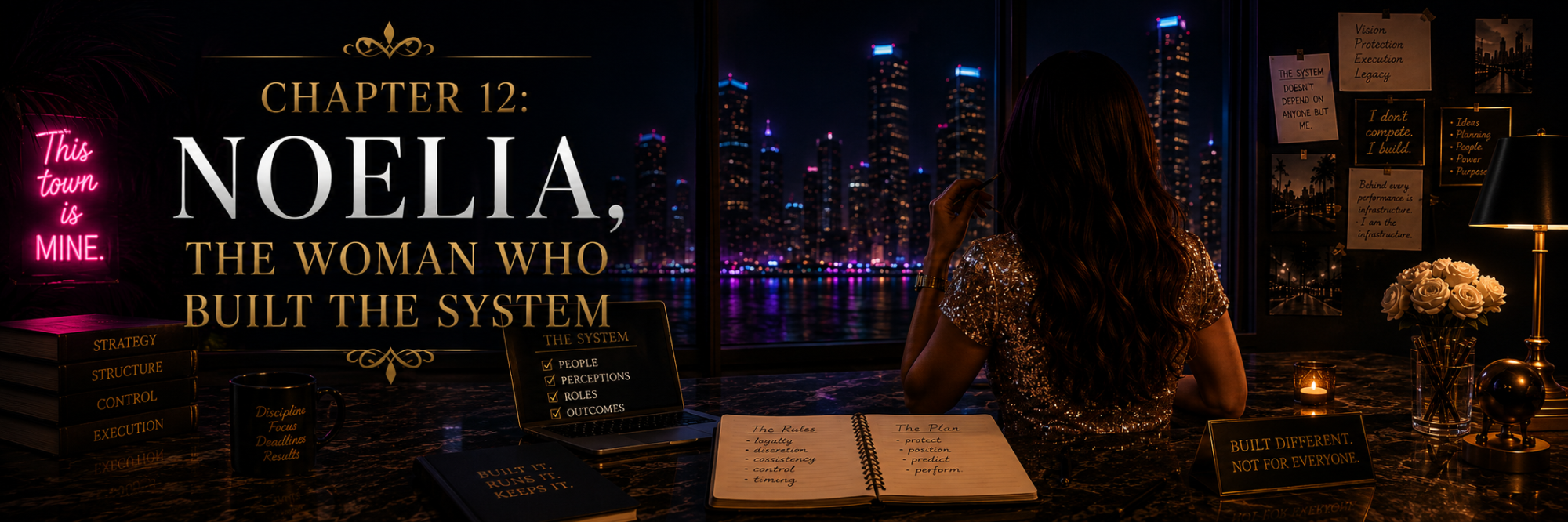
Excerpts from Chapter 12:
She moved through life with an operational mindset disguised as warmth, constantly building, stabilizing, and strengthening whatever she believed in—people, relationships, environments, and ideas. If she saw potential in something, she instinctively began shaping the conditions that would allow it to survive.
That instinct carried both her magic and her flaw.
Even now, she found herself trying to understand how someone she cared about could have understood her so differently from the way she understood herself.
When someone like that disappears from your daily life, you don't just miss the person.
You miss the rhythm.
Some people enter our lives not to stay forever, but to awaken parts of ourselves we didn't know were there. were there.

She already had structure. A life that made sense. Friends, independence, purpose, a sense of direction that didn’t require permission from anyone else.
Then Carlos entered it.
As the months passed, the contradictions became harder for Noelia to ignore. She began noticing inconsistencies in the stories she heard. Relationships fractured. Questions and rumors accumulated around the edges of their world. There were moments of generosity and kindness, but also moments that felt manipulative, self-serving, or performative.
It became a story about charisma and self-deception, about the masks people wear and the stories they tell themselves to survive. About loyalty and discernment. About connection, manipulation, hope, denial, and the slow unraveling of the identities people had built around themselves.
Part IV: The Kingdom of Appearances
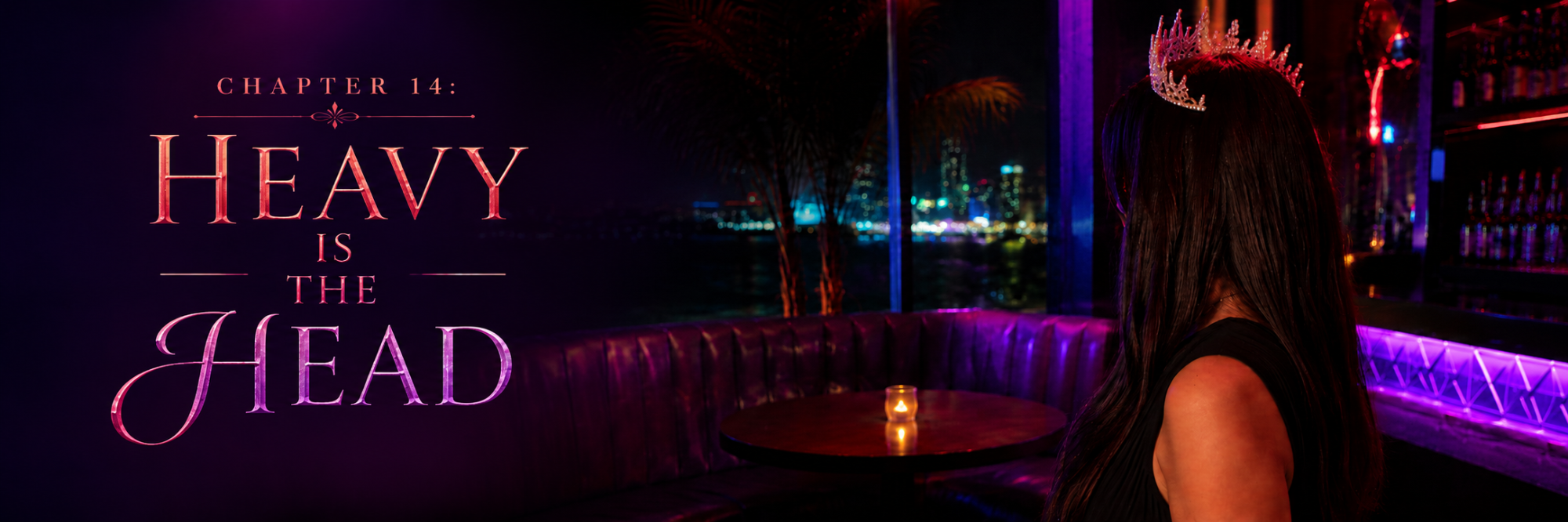
Part V: The Seatbelt; Just Strap In
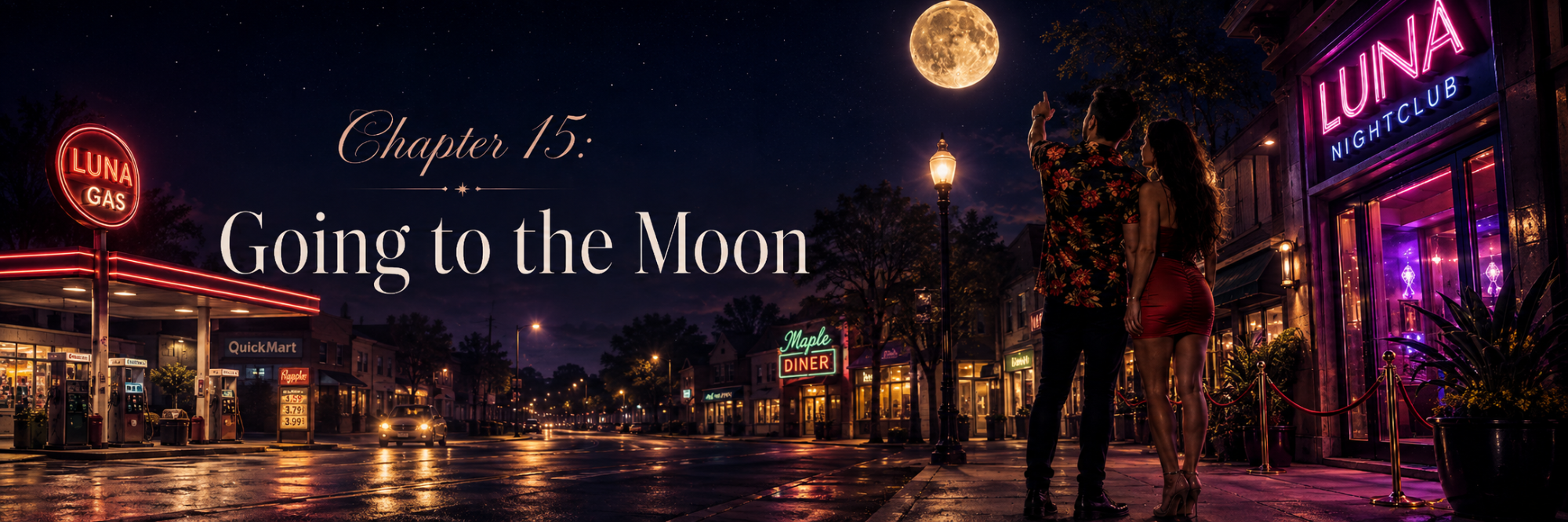
Excerpts of Chapter 15:
What began as a social circle slowly revealed itself to be something far more complicated.
"You are mine for the rest of your life."
What made everything harder was that the relationship did not exist in isolation. It lived inside a larger ecosystem where friendships, attraction, nightlife, loyalty, status, shared projects, and emotional dependencies constantly overlapped. Boundaries became difficult to define because personal and operational dynamics were rarely separate.
Part VI: The Cracks

Excerpts of Chapter 16:
But smoke has a way of burning through ambiguity.
The fire became another story added to an already crowded pile of stories.

Excerpts of Chapter 17:
His defensiveness arrived almost before the accusation finished landing.
The more she tried to explain herself, the more she felt he interpreted her words as an attempt to destroy him.
And somewhere beneath the accusations, the defensiveness, the fear, the resentment, and the silence, sat a truth neither seemed able to reach anymore.
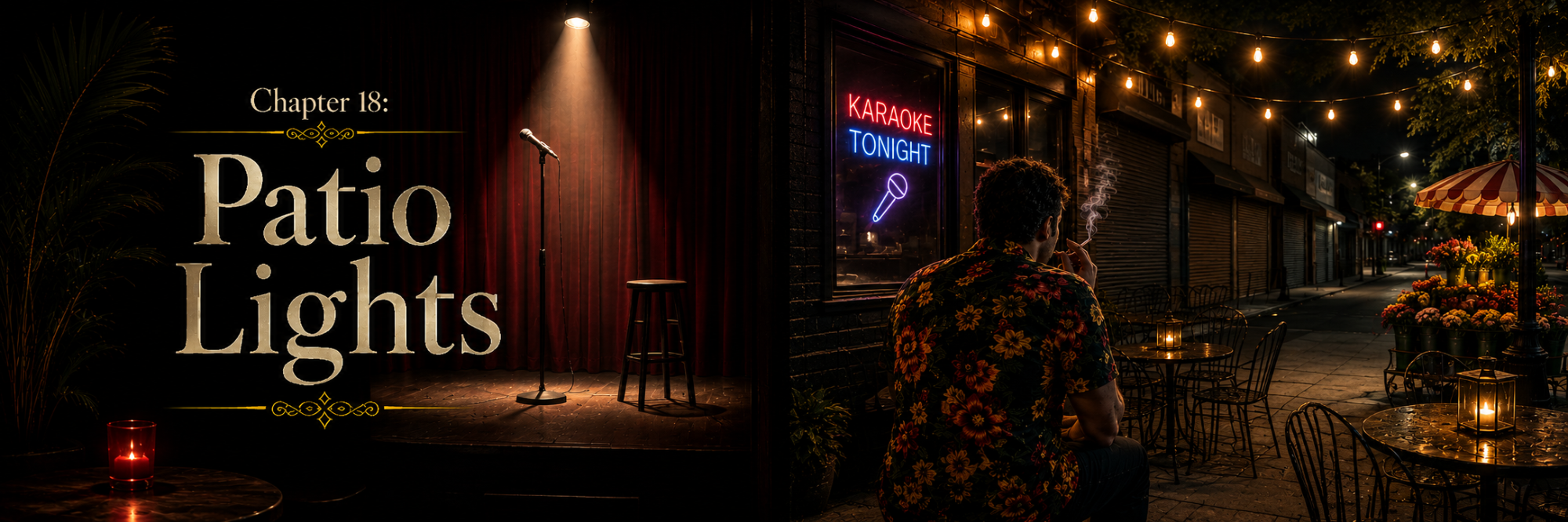
Excerpts of Chapter 18:
From Noelia’s perspective, Carlos seemed most unsettled when a woman beside him became his equal rather than his admirer.
She began to notice a painful pattern: the more visible she became beside him, the smaller she felt afterward.
At some point, both people have to stop pretending the cracks are manageable and decide whether they are actually willing to rebuild the structure honestly.

Epilogue
By the time I started referring to it as an exit interview, I think part of me already knew the relationship, at least in the form I wanted it, was dying.
Not dramatically. Not explosively.
Quietly.
That was the hardest part.
There was no singular betrayal. No catastrophic moment. No screaming match that burned everything to the ground.
Just emotional erosion over time.
Tiny disappointments. Repeated misunderstandings. Unresolved conversations. Inconsistency.
Emotional exhaustion. And a connection that, however real it had once felt, no longer translated into emotional safety.
I think people imagine heartbreak as anger, but for me it felt more like grief mixed with clarity.
And clarity is brutal.
Especially when you can still see all the good in someone while simultaneously realizing the relationship is hurting you.
That’s a very confusing place to exist emotionally.
Because even toward the end, I still saw him the same way I always had:
Handsome. Brilliant. Charismatic. Driven. Funny. Complex. Capable of extraordinary things.
That never disappeared for me.
What disappeared was my ability to keep sacrificing my emotional well-being in order to preserve the connection exactly as it was.
At some point, I started recognizing how much of myself I had abandoned trying to make everything work.
I became smaller emotionally. More anxious. More hypervigilant. More reactive to shifts in tone, attention, and affection. I started questioning my instincts instead of trusting them. I started minimizing my own hurt because I understood his pain so deeply.
And the irony is that understanding someone deeply can sometimes trap you longer than love itself.
Because every time I felt hurt, part of me immediately explained him back to myself.
He’s overwhelmed.
He’s stressed.
He’s scared.
He’s burned out.
He’s struggling.
He doesn’t mean it that way.
He just doesn’t know how.
Maybe all of those things were true.
But eventually I had to confront another truth:
Intent does not erase impact.
That realization changed everything for me.
I also had to admit that somewhere along the way, I stopped feeling emotionally cherished and started feeling emotionally managed.
There’s a difference.
One feels warm.
The other can begin to feel strategic.
And because I notice patterns, I began to experience his choices as an attempt to preserve comfort, flexibility, appearances, and access to different parts of his life at the same time.
Whether that was actually his intention, I could never know.
From where I stood, though, he seemed remarkably skilled at moving between spaces and people.
And if I’m honest, part of me even admired that ability.
But eventually I realized I did not want to compete for emotional consistency from someone who once made me feel so uniquely chosen.
That realization broke something in me quietly.
The hardest thing to accept was that I don’t think he ever fully understood the depth of what I actually gave him.
Not gifts.
Not support.
Not introductions.
Not loyalty.
Not sexuality.
Me.
My attention.
My emotional energy.
My softness.
My belief in him.
My consistency.
My trust.
My vulnerability.
My peace.
My nervous system.
Those things cost something.
And while I know he appreciated me in many ways, appreciation and emotional stewardship are not the same thing.
Toward the end, I found myself oscillating between wanting to hold on tighter and wanting to disappear completely.
Some days I wanted to fight for us.
Other days I wanted to quietly reclaim myself before I lost even more of who I was in the relationship.
I think that’s when I finally understood something important: love is not supposed to require abandoning yourself in order to sustain it.
That realization did not make me love him less.
It just made me love myself enough to stop pretending I could survive indefinitely on emotional breadcrumbs mixed with intense chemistry and potential.
Potential is seductive.
Especially for women like me who naturally see the best in people.
But potential cannot hug you consistently.
It cannot reassure you.
It cannot communicate clearly.
It cannot regulate emotional chaos.
It cannot sustain intimacy long-term without accountability.
Reality eventually collects its debt.
And ours came due slowly.
Still, I don’t regret loving him.
I don’t regret believing in him.
I don’t regret supporting him.
I don’t regret the conversations, the laughter, the intimacy, the evolution, the growth, or the memories.
What I regret is how long it took me to realize that loving someone deeply does not automatically mean the love between you can provide what you need to remain emotionally whole beside them.
The exit interview was never about blame.
It was about honesty.
About finally sitting with the reality that we created something beautiful, intoxicating, meaningful, and transformative together—
but not necessarily sustainable.
And maybe that’s what some relationships are.
Not failures.
Not forever.
Not mistakes.
Just experiences powerful enough to permanently alter the way you understand love, desire, devotion, grief, and yourself.
He changed me.
But in the end, I had to choose whether I was going to remain inside the kingdom trying to repair cracks alone…
or walk away carrying the parts of myself I still had left.
So I chose myself.
Quietly.
Painfully.
Finally.